
The recent depreciation of the rupee against the US dollar is unlikely to ensure better margins for exporters as buyers in Europe and the US, facing lower demand in their countries, are asking for hefty discounts.
Forex dealers said besides heavy selling of the American currency by banks and exporters, a higher opening in the domestic stock market, supported the rupee.

Globally, the dollar index was trading up by 0.1 per cent against the basket of six major currencies on optimism that the US economy is improving.

Adani Green Energy Ltd, the renewable energy arm of billionaire Gautam Adani's conglomerate, on Thursday scrapped a Rs 600 million bond issue after its promoter was charged in an alleged bribery case in the US. Hours before the US prosecutors charged Gautam Adani and associates with participating in a scheme to pay over Rs 250 million bribe to Indian officials in exchange for favourable terms for solar power contracts, the firm sold a 20-year green bond in the US-investment-grade market.
US is not going to do the kind of sequential taper that was hinted in May, said FM.

With short-term rates firming up due to tight liquidity conditions, Indian corporates are opting to borrow long term to take advantage of the attractive rates by locking them in these uncertain times. The banking system has a liquidity deficit of over Rs 2 trillion. According to market participants, engineering conglomerate Larsen & Toubro (L&T) raised Rs 1,500 crore through 10-year bonds in December 2024.

The rupee shed 6 paise to hit a fresh 1-month low of 62.31 on Thursday.
Rupee climbs further to fresh nine year high of 39.785 against the US dollar

With the rupee crossing Rs 72/dollar in recent times, things suddenly don't look too good on several counts.

A weak rupee, though seemingly good for exporters, would push up input cost further for Indian companies.

'Does 99 percent guarantee character and capacity for an independent awareness of life or does it make you -- barring exceptions -- a compliant careerist beholden to governments and corporations?' 'What kind of political and social choices would such minds make?' asks Shyam G Menon.
Software leaders are quite robust.

Indian airline industry is expecting to prune its net losses to Rs 3,000-5,000 crore in this fiscal from an estimated Rs 17,000-17,500 crore in FY2023 on the back of improved yields and stable cost environment, credit ratings agency ICRA said on Tuesday. At the same time, ICRA also estimated that domestic air passenger traffic will expand by 8-13 per cent each in FY2024 and FY2025. The rating agency has also maintained its stable outlook on the industry in view of healthy passenger traffic growth, improved yields and a stable cost environment.
Rupee's misunderstood fall is far from over despite some near-term respite.

There are reports that the government will soon cut income taxes by about Rs 50,000 crore to boost consumption.
Prime Minister Modi, I suggest that, instead, you distribute about one lakh crore rupees per year to the 80 crore poor, which will boost both consumption and economic growth, suggests Kalyan Singhal, McCurdy Professor of Business at the University of Baltimore.
The depreciating Indian rupee creates new opportunities.

Forex dealers attributed the fall to increased demand for the dollar.

Crude oil hit an all time high in rupee terms; Tuesday figures expected to be higher

Foreign investors made a significant turnaround and injected over Rs 1,500 crore into Indian equities in February, reversing the massive outflows seen in the preceding month, primarily due to robust corporate earnings and positive economic growth. Additionally, Foreign Portfolio Investors (FPIs) continued to be bullish on the debt markets as they put in over Rs 22,419 crore during the month under review, data with the depositories showed. Looking ahead to March, the outlook for FPI flow appears promising, provided the current economic trajectory and corporate performance sustain their positive momentum, potentially continuing to attract foreign investment into Indian equities, Mayank Mehraa, smallcase manager and principal partner at Craving Alpha, said.

Rupee falls 5 paise against dollar, ends at 61.92.
The rupee will join the elite club of US dollar, British pound-sterling, Euro and Japanese yen to have its own symbol.

The hapless voters fervently hope that they get to make a more equal choice in the next election and political discourse in the country becomes positive and more enlightened. One wonders if the masses would become more politically aware to discern good intent and performance from gimmickry, notes Biswajit Dasgupta.

Trading sentiment in the equity market this week will be guided by global trends, foreign fund movement, macroeconomic data announcements and RBI's interest rate decision, analysts said. The monthly auto sales data announcement would also be tracked by investors this week.

Might earn around Rs 3,720 crore on export of 2 mt of wheat, despite dipping prices in international markets
While all the four countries have seen a sharp rise in their currencies against the US dollar, the pace of rupee appreciation is only next to the Brazilian real since the beginning of this year.

The Indian rupee strengthened 12.9 per cent against US dollar during the year ended March, 2010, touching Rs 45.14, on the back of foreign capital inflows, Parliament was informed on Tuesday.

Overseas Indians deposited around $4 billion in non-resident Indian (NRI) deposit schemes in April - June FY25, up 79 per cent over the amount deposited in these schemes in the same period last year, data released by the Reserve Bank of India (RBI) on Monday showed. In April - June FY25, inflows into the NRI schemes stood at $3.95 billion, compared to $2.21 billion during the same period a year ago. With this, the total outstanding NRI deposits as of June stood at $155.71 billion.

Trading activity of foreign investors and global trends will be the major driving factors for the equity markets in a holiday-shortened week ahead, according to analysts. Leading stock exchanges BSE and NSE have declared a trading holiday on November 20 for assembly elections in Maharashtra. Elections to the 288-member state legislative assembly will be held on November 20, and votes will be counted on November 23.

Foreign investors have bought around $2.4 billion in both debt and equity so far in October, pushing the total inflows to nearly $36 billion so far in the year.

A Delhi court has convicted former Congress MP Sajjan Kumar of murder in a 1984 anti-Sikh riots case. The court found that Kumar was part of an unlawful assembly that killed the victims and is guilty of the murders of Jaswant Singh and Tarundeep Singh. Kumar now faces a maximum of the death penalty and a minimum of life in prison. The court rejected Kumar's argument that the statement of the complainant couldn't be trusted, as she named him belatedly and held at the time of the incident she was not aware of the identity of the accused as she was admittedly new to the area and had never seen him earlier. The court also found the other residents of the locality were reluctant to come forward to aid the victims at the time of the incident, leading to the conclusion that they would also not support the victims' version in court.

In Kerala's society, known for its high material standard of living, plunging into a state of having nothing overnight can be terrible for one's social standing and sense of self-esteem. Rehabilitation entails piecing a community back together after a disturbance and while its aim is noble, the act of reassembling will bring alive disparities and inequalities, explains Shyam G Menon.

The rupee fell by 49 paise to close at 81.89 (provisional) against the US dollar on Monday as heavy selling pressure in the domestic equities and a spike in crude oil prices weighed on the local unit.

The Union government will soon make amendments to the foreign trade policy (FTP) to enable exporters to claim export benefits for settling trade in rupees. These benefits are, so far, available for export payments received in foreign currencies. After the Reserve Bank of India (RBI) unveiled a mechanism to settle international trade transactions in the local currency on Monday, exporters have been demanding that the Ministry of Commerce and Industry come up with a clarification on the matter.

From the 30-share Sensex pack, Tata Consultancy Services, Infosys, NTPC, HCL Technologies, Axis Bank, Tech Mahindra, Bajaj Finserv, Sun Pharma, IndusInd Bank and Reliance Industries were the major laggards. Tata Steel, Hindustan Unilever, Mahindra & Mahindra, Nestle and State Bank of India were among the gainers.

The answer depends on your financial goals and risk appetite, says Certified Financial Planner Ramalingam Kalirajan, and explains why.

With its age-old fascination for education, southern states have done better than the North. Start-ups, IT hubs, and industry majors setting up shop have changed the face of the South. Nearly 79% of global offices set up by international conglomerates in India are in the South. Almost 46% of tech unicorns are from the South. The GDP per person in the South is 4.2 times higher than the North. None of these indicators can be ignored by any central government, whatever the political compulsions, notes Ramesh Menon.

A lower opening in the domestic equity market put pressure on the rupee.
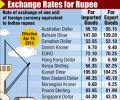
Forex dealers said strength in euro against the US dollar overseas and increased capital inflows supported the rupee.

A host of macroeconomic data announcements, the last batch of September quarter earnings, global trends, and trading activity of foreign investors will be the major driving factors for the equity market this week, according to analysts. Equity markets would remain closed on Friday for Guru Nanak Jayanti. "India is set to release CPI and IIP data on November 12, with WPI data expected on November 14.
